


How Much Does a Floating Staircase Cost in 2026?

Floating staircases are one of the most in-demand features we build at Iron Timbers, and one of the biggest questions homeowners, builders, and designers have is simple: how much do they cost? In 2026, most custom floating staircase projects fall within a fairly wide range depending on design, engineering, materials, finish details, and installation conditions. In this guide, we'll break down the main cost drivers, realistic price ranges, and what to expect when budgeting for a custom floating staircase.
Cost isn't the only question homeowners ask. Safety is just as important. If you're wondering how floating staircases meet building codes and whether they're safe for families, read our guide on Are Floating Staircases Actually Safe?
What Is the Typical Cost of a Floating Staircase in 2026?
Most custom floating staircases fall within a $16,000 to $28,000+ range for a single-floor configuration. Because every staircase is custom, there isn't a one-size-fits-all price. The final investment depends on factors such as the staircase layout, engineering requirements, material selections, railing design, and overall project complexity. Understanding the different types of floating staircases is a great place to start, since each configuration comes with its own design considerations and cost implications.

What Impacts Floating Staircase Cost the Most?
The biggest factors that affect price are usually the following:
Stair configuration (straight run, switchback, or winder)
Tread wood species and thickness
Railing design and material selection
Overall design complexity and custom detailing
Shipping location and logistics
All Iron Timbers staircase systems are fabricated in-house and shipped nationwide. Because of this, project location plays a role in overall cost, while installation is handled by the client or their contractor.
Looking for a more detailed breakdown? Our Floating Staircase Pricing Guide explains pricing by staircase configuration—including straight runs, switchbacks, and winder staircases—as well as the factors that affect overall cost.
Why Some Floating Staircases Cost More Than Others
Not all floating staircases are built the same. Some companies offer modular, kit-based systems that are designed for simplicity and lower cost. Others operate as fully custom fabricators, where every project is engineered and built from scratch with little standardization.
At Iron Timbers, we take a different approach. Our staircase systems are purpose-built for each project using proven designs and refined processes. This allows us to deliver a high-end, custom look and feel without the excessive complexity, long timelines, or unpredictability that can come with fully one-off builds.
The result is a staircase that balances quality, efficiency, and consistency. You’re not getting a pre-packaged kit, but you’re also not stepping into an overly complicated custom process. You’re getting a system that has been thought through, built with precision, and designed to perform long term.
Popular Floating Staircase Designs
The layout of your staircase plays a major role in both the design and overall investment. Here are the three most common floating staircase configurations we build.
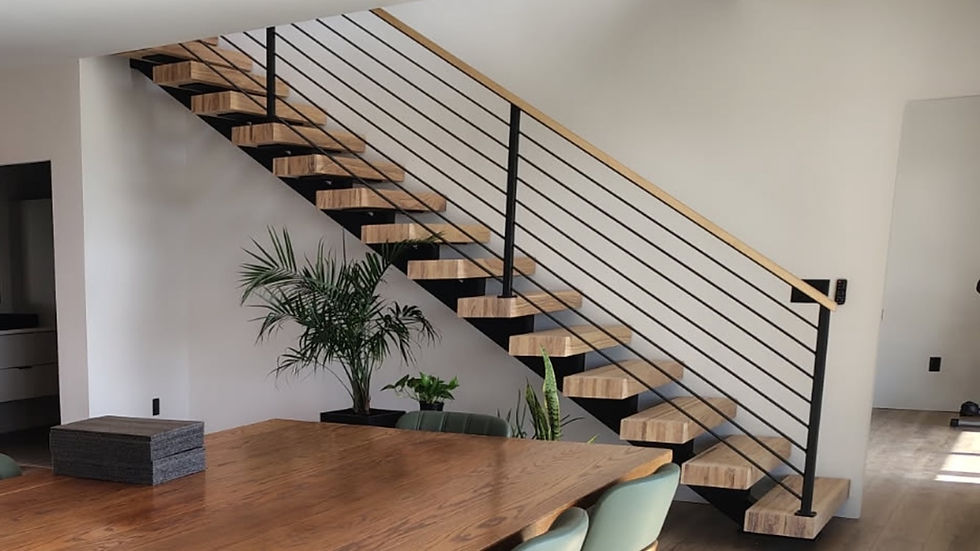
Straight Run Floating Staircases
Straight-run floating staircases are the simplest and most efficient staircase design. With a single uninterrupted run, they're often the best choice for modern homes looking for a clean, minimalist aesthetic. Their straightforward layout also makes them easier to plan and install than more complex staircase designs.

Switchback Staircases
Switchback floating staircases incorporate a landing and reverse direction to fit within a smaller footprint while maintaining a dramatic architectural appearance. They're a popular choice for two-story homes where space efficiency is important without sacrificing design.

Winder Staircases
Winder floating staircases use angled treads to transition around corners instead of full landings. They provide an elegant solution when space is limited while still creating the open appearance that floating staircases are known for.
Want a detailed cost breakdown? Our Floating Staircase Pricing Guide compares straight-run, switchback, and winder staircases while explaining the biggest factors that affect total project cost.
How Iron Timbers Compares to Modular Stair Systems
Some staircase systems on the market are modular or kit-based, which can come in at a lower initial price point. These systems are designed for standardization and simplified installation, often using pre-determined components that are adjusted to fit a space.
At Iron Timbers, our staircases are built differently. Each system is fabricated for the specific project with a focus on structural integrity, material quality, and long-term performance.
Because our systems are built around a refined and efficient process, we’re able to deliver a high-end staircase at a more accessible price point than many fully custom one-off builds.
The result is a system that offers the best of both worlds. You’re not getting a one-size-fits-all kit, but you’re also not taking on the cost and complexity of a fully custom, from-scratch build. You’re getting a staircase that is built for your space, built to last, and designed to perform long term.
What Information Do We Need to Price Your Staircase?
Every floating staircase is custom, so there isn't a one-size-fits-all price. The more information we have about your project, the more accurate your estimate will be. While we can provide general pricing guidance, a detailed quote is based on your home's layout, structural requirements, and design preferences.
To prepare an accurate estimate, we typically ask for:
Rise and Run of opening
Floor-to-floor height
Straight, switchback or winder
Preferred wood species
Railing style
Zip code for shipping
New construction vs remodel
Even if you don't have every detail yet, don't worry. Our team can help determine the right staircase configuration and walk you through the information needed to provide an accurate proposal.
When a Floating Staircase May Not Be the Right Fit
While floating staircases create a clean and modern look, they’re not the right fit for every project. Structural limitations, tight spaces, or budget constraints can all impact whether a floating system makes sense.
In some cases, a more traditional staircase design may be a better option depending on the layout and overall goals of the project.
Our goal is always to help determine the right solution for the space, not force a system where it doesn’t belong.
Want to see what's possible? Explore our Floating Staircase Systems page to view project galleries, learn about our construction process, and discover the design options available for your home.
Ready for an Accurate Staircase Price?
Every floating staircase is custom, but an accurate quote starts with understanding your layout, goals, and design preferences. Our team can review your project and provide a personalized estimate.


Comments